

The Leaky Bucket Problem
When a business owner notices the phone isn't ringing, the first reaction is almost always to chase more traffic.
They spend money on search ads, run campaigns on social media, or pay for regular blog posts. People click through and visit the page, but the inbox stays quiet.
Pouring more traffic into a site that doesn't convert just wastes budget faster. If 300 qualified people visit your site this month and nobody contacts you, sending 1,000 visitors simply means 1,000 people leave without saying a word.
Traffic only matters once the page itself knows how to turn a curious visitor into a real conversation. When visitors land and immediately bounce, a few specific issues on the page are usually getting in their way.
1. Pitching Before You Listen
In negotiation and psychology, there is a concept called tactical empathy: people only listen to your offer after they feel certain that you understand their problem.
Most business websites do the exact opposite on screen one. They open with self-centered statements:
Addressing the Customer's Pain First
A customer arriving on your site usually has an urgent headache. They might have broken equipment costing them revenue every hour, a serious legal situation, or a burst pipe in their building.
When your main headline talks only about your awards and company history, the visitor quickly decides this page is about the company, not about them.
High-converting pages address the visitor's situation first. The headline names the exact problem, acknowledges what is at stake, and points to a clear next step. Once a prospect sees their own situation reflected on the screen, they stay and read.
- "Welcome to our firm, providing premium solutions since 2012."
- "We are a full-service leader in customer excellence."

2. Cognitive Overload and Hick’s Law
A well-known rule of human behavior, Hick’s Law, shows that the time it takes someone to make a choice increases with every additional option you put in front of them.
Give visitors too many paths, and they choose none of them.
A typical service website often looks like this:
The Power of Single-Objective Pages
When someone runs into five competing actions at once, decision fatigue kicks in. In that moment, the easiest move is simply tapping the back button and leaving.
Every page should focus on one main objective. If the goal is getting an inbound phone call, every section and button should support that specific goal. Cutting out the extra widgets and links gives your visitor a clear, obvious path forward.
- A navigation bar packed with seven dropdown menus.
- A floating social bar pulling visitors away to external apps.
- A newsletter signup pop-up interrupting their reading.
- Multiple buttons scattered across the screen asking for different things.
3. Asking for Too Much on the First Touch
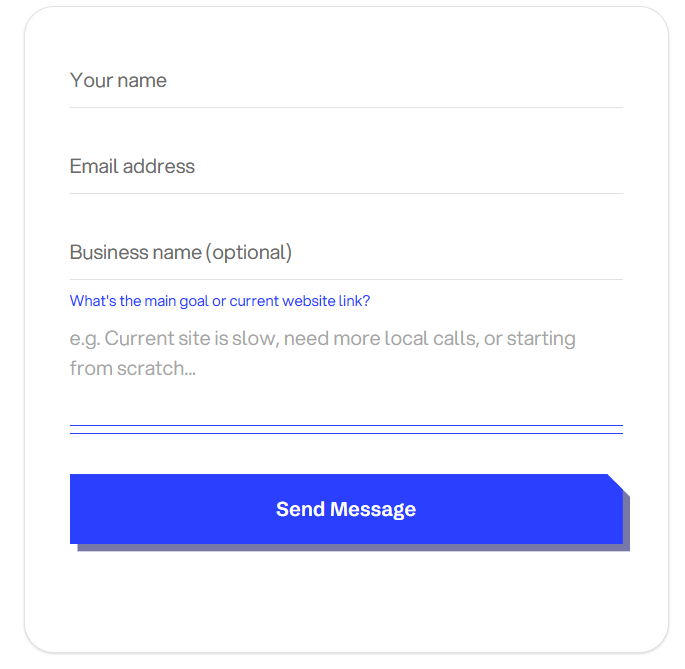
Another common leak is form design.
Many businesses treat a first-time contact form like a formal client intake questionnaire. They ask for full legal names, company revenue, budget brackets, project deadlines, and several paragraphs of background details.
Psychological research on commitment shows that people follow through much more easily when the initial step feels small and safe.
Someone reaching out for the first time usually just wants to find out if you can help and what it might cost. They don't want to complete paperwork before they even know who they are dealing with.
The Website's Real Job
The website's role is simply starting the conversation. Once you have their name and phone number, you can easily gather the rest of the project details during a five-minute introductory call.
- Heavy forms (6 to 9 fields): Visitors hesitate, abandon the page, and look elsewhere.
- Light forms (Name, Phone, Email): Visitors complete the inquiry in thirty seconds.
4. Vague Testimonials vs. Concrete Proof
Almost every business site includes a review section with quotes praising "great service" and "friendly communication."
Most people skim right past generic praise because every competitor claims the exact same thing.
Trust builds much faster around specific, verifiable facts:
Details Destroy Skepticism
Specific details answer skepticism. Generic compliments get overlooked.
- Instead of "They did great work," highlight "They diagnosed our system issue in 48 hours and got us back online before the weekend."
- Include real names, actual job titles, and locations whenever possible.
- Mention concrete outcomes, case dismissals, or project milestones.
The Takeaway
If your website gets consistent visitors but few inquiries, hold off on spending more money on search or social ads.
Take a fresh look at the experience from the eyes of a busy visitor:
Fix Friction First
Fix the friction on the page first, and the traffic you already have will start turning into real client conversations.
- Does your headline speak to their situation before talking about your business?
- Is there one primary next step, or are multiple links competing for attention?
- Does reaching out take thirty seconds, or does it feel like paperwork?